

Visitor Pattern

The Visitor Pattern is a behavioral design pattern that lets you add new operations to existing class hierarchies without modifying them. Instead of putting the new behavior inside the classes, you move it into a separate "visitor" object that travels through the structure.
Think of a tax auditor visiting different types of businesses—a restaurant, a factory, a shop. Each business type is taxed differently, but the auditor knows how to handle each. The businesses don't change; the auditor brings the logic. That's the Visitor Pattern.
The Problem
Imagine you have a hierarchy of shapes—Circle, Rectangle, Triangle. You need to add operations like area calculation, rendering, and XML export—but you don't want to bloat the shape classes:
// Without Visitor Pattern - bloated classes
class Circle {
    double radius;

    double calculateArea() { return Math.PI * radius * radius; }

    // Now add rendering - bloats Circle
    void render() { System.out.println("Rendering circle..."); }

    // Now add XML export - even more bloat
    String toXML() { return "<circle radius='" + radius + "'/>"; }

    // Every new operation forces changes to Circle (and every other shape)!
}
Problems:
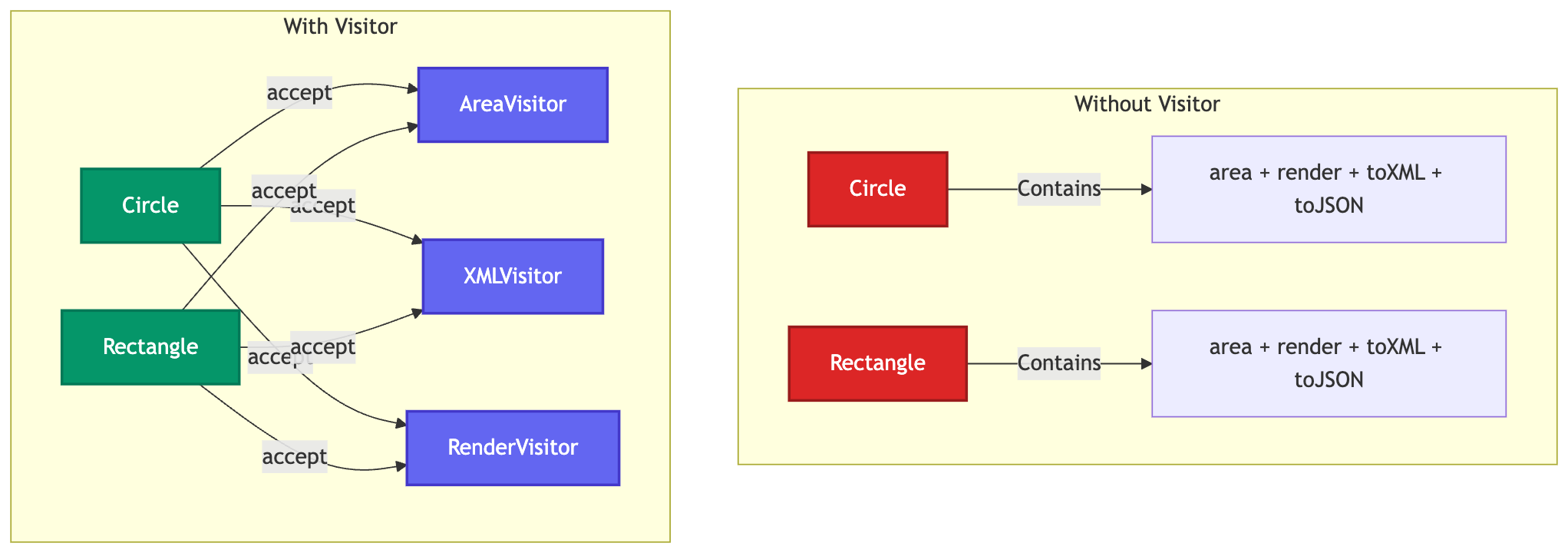
Open/Closed Violation: Every new operation forces changes to every class in the hierarchy
Class Bloat: Shape classes accumulate unrelated operations
Hard to maintain: Adding
toJSON(),serialize(),validate()means modifying every shapeScattered logic: Related operation logic (e.g., all XML exports) is spread across classes
The Solution: Visitor Pattern
The Visitor Pattern extracts operations into visitor objects. Each shape just accepts a visitor and delegates the operation to it.
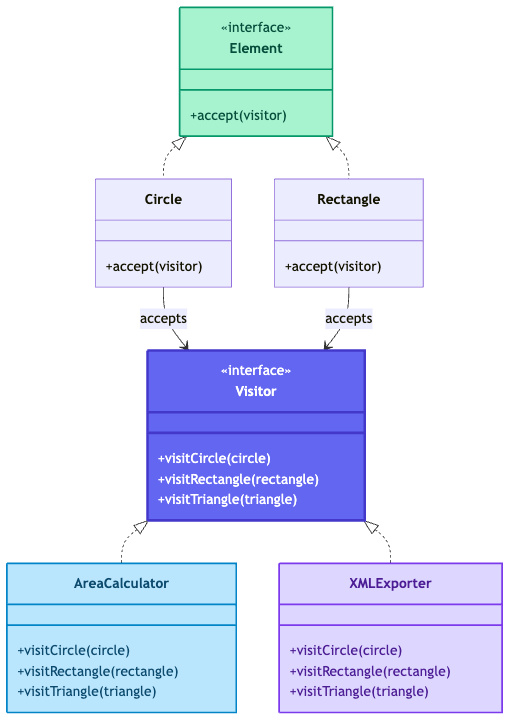
The pattern separates:
What you traverse (Elements — shapes, nodes, files)
What you do (Visitors — operations like export, calculate, render)
How It Solves Each Problem
| Problem | How Visitor Pattern Solves It |
|---|---|
| Open/Closed Violation | Add new operations by adding new Visitor classes—no element changes needed. |
| Class Bloat | Operations live in Visitor classes, not in shape classes. |
| Hard to maintain | All logic for one operation is centralized in one Visitor. |
| Scattered logic | Related operation code (e.g., all XML exports) lives together. |
Key Components
Visitor: Interface with a
visitmethod for each element typeConcreteVisitor: Implements the operation for each element type
Element: Interface declaring
accept(visitor)methodConcreteElement: Calls the correct
visitmethod on the visitorObject Structure: Collection of elements the visitor traverses
How It Solves the Problem
Real-World Implementation
Example 1: Shape Operations (Area, XML Export, Rendering)
import java.util.List;

// Visitor Interface
interface ShapeVisitor {
    void visitCircle(Circle circle);
    void visitRectangle(Rectangle rectangle);
    void visitTriangle(Triangle triangle);
}

// Element Interface
interface Shape {
    void accept(ShapeVisitor visitor);
}

// Concrete Elements
class Circle implements Shape {
    double radius;

    public Circle(double radius) {
        this.radius = radius;
    }

    @Override
    public void accept(ShapeVisitor visitor) {
        visitor.visitCircle(this);
    }
}

class Rectangle implements Shape {
    double width;
    double height;

    public Rectangle(double width, double height) {
        this.width = width;
        this.height = height;
    }

    @Override
    public void accept(ShapeVisitor visitor) {
        visitor.visitRectangle(this);
    }
}

class Triangle implements Shape {
    double base;
    double height;

    public Triangle(double base, double height) {
        this.base = base;
        this.height = height;
    }

    @Override
    public void accept(ShapeVisitor visitor) {
        visitor.visitTriangle(this);
    }
}

// Concrete Visitor 1 - Area Calculator
class AreaCalculator implements ShapeVisitor {
    private double totalArea = 0;

    @Override
    public void visitCircle(Circle circle) {
        double area = Math.PI * circle.radius * circle.radius;
        totalArea += area;
        System.out.printf("Circle area: %.2f%n", area);
    }

    @Override
    public void visitRectangle(Rectangle rectangle) {
        double area = rectangle.width * rectangle.height;
        totalArea += area;
        System.out.printf("Rectangle area: %.2f%n", area);
    }

    @Override
    public void visitTriangle(Triangle triangle) {
        double area = 0.5 * triangle.base * triangle.height;
        totalArea += area;
        System.out.printf("Triangle area: %.2f%n", area);
    }

    public double getTotalArea() {
        return totalArea;
    }
}

// Concrete Visitor 2 - XML Exporter
class XMLExporter implements ShapeVisitor {
    private StringBuilder xml = new StringBuilder();

    @Override
    public void visitCircle(Circle circle) {
        xml.append(String.format("<circle radius='%.1f'/>%n", circle.radius));
    }

    @Override
    public void visitRectangle(Rectangle rectangle) {
        xml.append(String.format("<rectangle width='%.1f' height='%.1f'/>%n",
            rectangle.width, rectangle.height));
    }

    @Override
    public void visitTriangle(Triangle triangle) {
        xml.append(String.format("<triangle base='%.1f' height='%.1f'/>%n",
            triangle.base, triangle.height));
    }

    public String getXML() {
        return "<shapes>\n" + xml + "</shapes>";
    }
}

// Concrete Visitor 3 - Renderer
class ShapeRenderer implements ShapeVisitor {
    @Override
    public void visitCircle(Circle circle) {
        System.out.println("Rendering circle with radius " + circle.radius);
    }

    @Override
    public void visitRectangle(Rectangle rectangle) {
        System.out.println("Rendering rectangle " + rectangle.width + "x" + rectangle.height);
    }

    @Override
    public void visitTriangle(Triangle triangle) {
        System.out.println("Rendering triangle base=" + triangle.base);
    }
}

// Client
public class ShapeDemo {
    public static void main(String[] args) {
        List<Shape> shapes = List.of(
            new Circle(5),
            new Rectangle(4, 6),
            new Triangle(3, 8)
        );

        System.out.println("=== Area Calculation ===");
        AreaCalculator calculator = new AreaCalculator();
        shapes.forEach(s -> s.accept(calculator));
        System.out.printf("Total area: %.2f%n%n", calculator.getTotalArea());

        System.out.println("=== XML Export ===");
        XMLExporter exporter = new XMLExporter();
        shapes.forEach(s -> s.accept(exporter));
        System.out.println(exporter.getXML());

        System.out.println("=== Rendering ===");
        ShapeRenderer renderer = new ShapeRenderer();
        shapes.forEach(s -> s.accept(renderer));
    }
}
Example 2: AST (Abstract Syntax Tree) Evaluator
// Visitor for AST nodes
interface ExpressionVisitor {
    int visitNumber(NumberNode node);
    int visitAdd(AddNode node);
    int visitMultiply(MultiplyNode node);
}

// Element Interface
interface ExpressionNode {
    int accept(ExpressionVisitor visitor);
}

// Concrete Nodes
class NumberNode implements ExpressionNode {
    int value;

    public NumberNode(int value) {
        this.value = value;
    }

    @Override
    public int accept(ExpressionVisitor visitor) {
        return visitor.visitNumber(this);
    }
}

class AddNode implements ExpressionNode {
    ExpressionNode left;
    ExpressionNode right;

    public AddNode(ExpressionNode left, ExpressionNode right) {
        this.left = left;
        this.right = right;
    }

    @Override
    public int accept(ExpressionVisitor visitor) {
        return visitor.visitAdd(this);
    }
}

class MultiplyNode implements ExpressionNode {
    ExpressionNode left;
    ExpressionNode right;

    public MultiplyNode(ExpressionNode left, ExpressionNode right) {
        this.left = left;
        this.right = right;
    }

    @Override
    public int accept(ExpressionVisitor visitor) {
        return visitor.visitMultiply(this);
    }
}

// Concrete Visitor - Evaluator
class Evaluator implements ExpressionVisitor {
    @Override
    public int visitNumber(NumberNode node) {
        return node.value;
    }

    @Override
    public int visitAdd(AddNode node) {
        return node.left.accept(this) + node.right.accept(this);
    }

    @Override
    public int visitMultiply(MultiplyNode node) {
        return node.left.accept(this) * node.right.accept(this);
    }
}

// Concrete Visitor - Printer
class ExpressionPrinter implements ExpressionVisitor {
    @Override
    public int visitNumber(NumberNode node) {
        System.out.print(node.value);
        return node.value;
    }

    @Override
    public int visitAdd(AddNode node) {
        System.out.print("(");
        node.left.accept(this);
        System.out.print(" + ");
        node.right.accept(this);
        System.out.print(")");
        return 0;
    }

    @Override
    public int visitMultiply(MultiplyNode node) {
        System.out.print("(");
        node.left.accept(this);
        System.out.print(" * ");
        node.right.accept(this);
        System.out.print(")");
        return 0;
    }
}

// Client
public class ASTDemo {
    public static void main(String[] args) {
        // Expression: (2 + 3) * 4
        ExpressionNode tree = new MultiplyNode(
            new AddNode(new NumberNode(2), new NumberNode(3)),
            new NumberNode(4)
        );

        System.out.print("Expression: ");
        tree.accept(new ExpressionPrinter());
        System.out.println();

        int result = tree.accept(new Evaluator());
        System.out.println("Result: " + result);
    }
}

/* Output:
Expression: ((2 + 3) * 4)
Result: 20
*/
Example 3: File System Visitor
import java.util.ArrayList;
import java.util.List;

// Visitor
interface FileSystemVisitor {
    void visitFile(FileNode file);
    void visitDirectory(DirectoryNode directory);
}

// Elements
interface FileSystemNode {
    String getName();
    void accept(FileSystemVisitor visitor);
}

class FileNode implements FileSystemNode {
    private String name;
    private long sizeKB;

    public FileNode(String name, long sizeKB) {
        this.name = name;
        this.sizeKB = sizeKB;
    }

    @Override
    public String getName() { return name; }

    public long getSizeKB() { return sizeKB; }

    @Override
    public void accept(FileSystemVisitor visitor) {
        visitor.visitFile(this);
    }
}

class DirectoryNode implements FileSystemNode {
    private String name;
    private List<FileSystemNode> children = new ArrayList<>();

    public DirectoryNode(String name) {
        this.name = name;
    }

    public void add(FileSystemNode node) {
        children.add(node);
    }

    public List<FileSystemNode> getChildren() { return children; }

    @Override
    public String getName() { return name; }

    @Override
    public void accept(FileSystemVisitor visitor) {
        visitor.visitDirectory(this);
        for (FileSystemNode child : children) {
            child.accept(visitor);
        }
    }
}

// Visitor 1 - Size Calculator
class SizeCalculator implements FileSystemVisitor {
    private long totalSize = 0;

    @Override
    public void visitFile(FileNode file) {
        totalSize += file.getSizeKB();
    }

    @Override
    public void visitDirectory(DirectoryNode directory) {
        System.out.println("Scanning directory: " + directory.getName());
    }

    public long getTotalSizeKB() { return totalSize; }
}

// Visitor 2 - File Lister
class FileLister implements FileSystemVisitor {
    private int depth = 0;

    @Override
    public void visitFile(FileNode file) {
        System.out.println("  ".repeat(depth) + "- " + file.getName()
            + " (" + file.getSizeKB() + " KB)");
    }

    @Override
    public void visitDirectory(DirectoryNode directory) {
        System.out.println("  ".repeat(depth) + "[" + directory.getName() + "]");
        depth++;
    }
}

// Client
public class FileSystemDemo {
    public static void main(String[] args) {
        DirectoryNode root = new DirectoryNode("root");
        DirectoryNode src = new DirectoryNode("src");
        DirectoryNode test = new DirectoryNode("test");

        src.add(new FileNode("Main.java", 12));
        src.add(new FileNode("Service.java", 34));
        test.add(new FileNode("MainTest.java", 8));

        root.add(src);
        root.add(test);
        root.add(new FileNode("README.md", 5));

        System.out.println("=== File Listing ===");
        root.accept(new FileLister());

        System.out.println("\n=== Total Size ===");
        SizeCalculator calculator = new SizeCalculator();
        root.accept(calculator);
        System.out.println("Total: " + calculator.getTotalSizeKB() + " KB");
    }
}
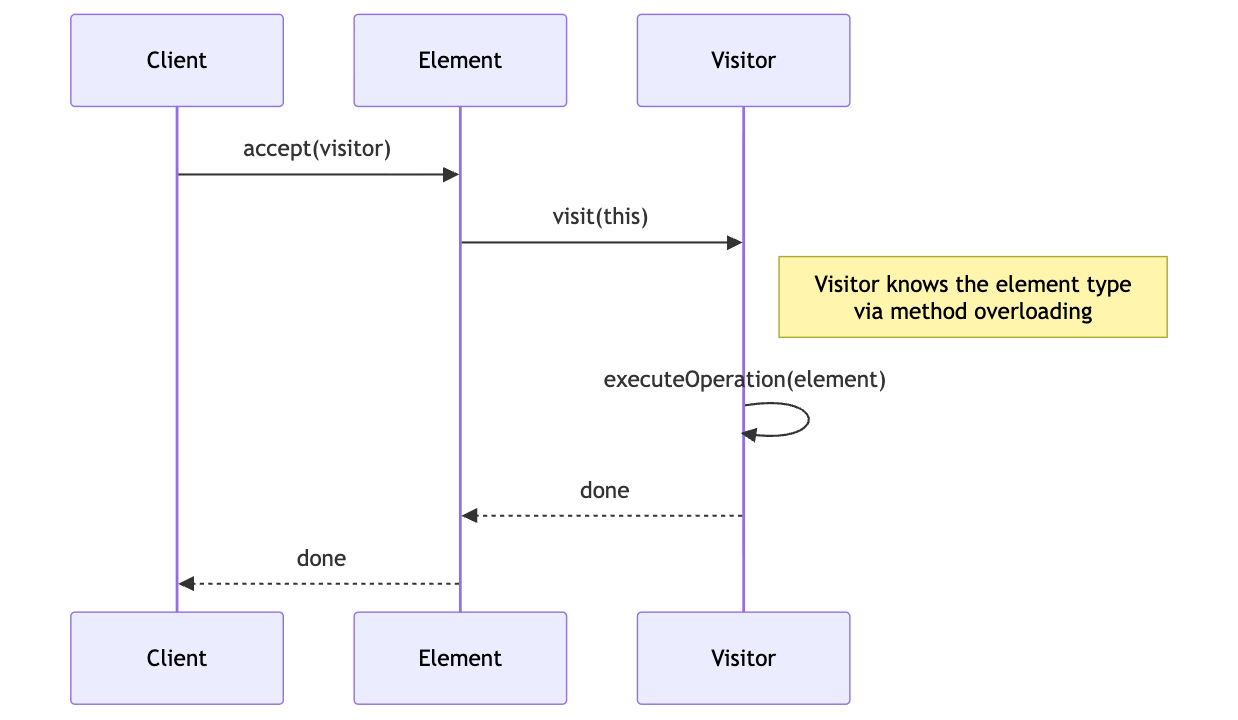
Workflow Diagram
Real-World Use Cases
Compilers: AST traversal for code generation, optimization, type checking
Document Processing: Export Word/PDF/HTML from the same document model
File Systems: Size calculation, search, permissions audit
Game Dev: Entity processing with different operations (render, update, physics)
Tax Engines: Different tax rules applied to different product/transaction types
Static Analysis Tools: Rules applied across a codebase's AST
XML/JSON Processors: Transforming or validating node trees
When to Use the Visitor Pattern
✅ Use When
Stable Hierarchy: Element classes rarely change, but operations change often
Multiple Operations: You need to perform many unrelated operations on elements
Avoid Pollution: You don't want to add operation logic into element classes
Centralized Logic: You want all related operation code in one place
❌ Avoid When
Frequent Hierarchy Changes: Adding a new element type forces updating every visitor
Simple Operations: A single method on each class is simpler
Private State: Visitors need access to element internals, which can be awkward
Benefits
Open/Closed Principle: Add new operations without touching element classes
Single Responsibility: Each visitor handles one concern
Related Logic Centralized: All XML export code lives in
XMLExporterDouble Dispatch: Runtime resolution of both element and visitor type
Drawbacks
Element Hierarchy is Closed: Adding a new element requires updating all visitors
Breaks Encapsulation: Visitors need access to element internals
Complexity: Boilerplate
accept()methods on every element
Visitor vs Strategy Pattern
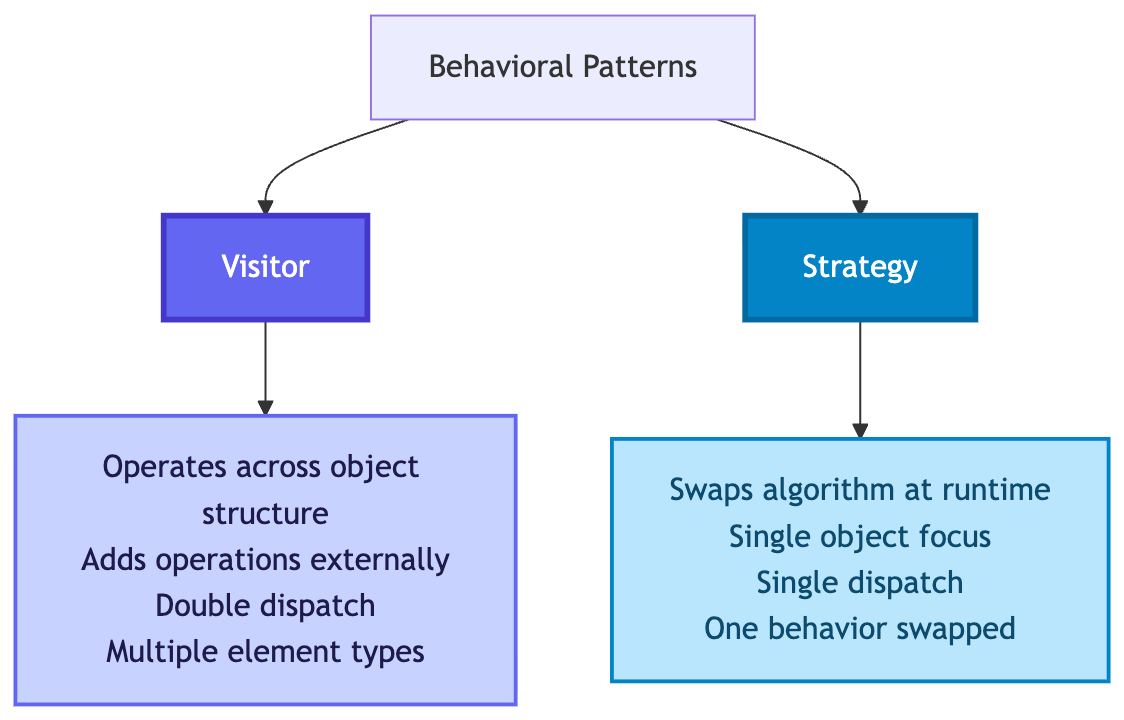
| Aspect | Visitor | Strategy |
|---|---|---|
| Scope | Object structure (many types) | Single object |
| Dispatch | Double dispatch | Single dispatch |
| Purpose | Add operations externally | Swap algorithms |
| Element Changes | Adds accept() once |
No changes needed |
Best Practices
Keep Elements Stable: Visitor shines when the element hierarchy is frozen
One Concern Per Visitor: Don't mix unrelated operations in one visitor
Minimize Element Exposure: Keep visitor access to the minimum needed
Accumulate State: Use visitor fields to collect results (e.g., total area)
Combine with Composite: Visitor works beautifully with Composite pattern for tree traversal
Conclusion
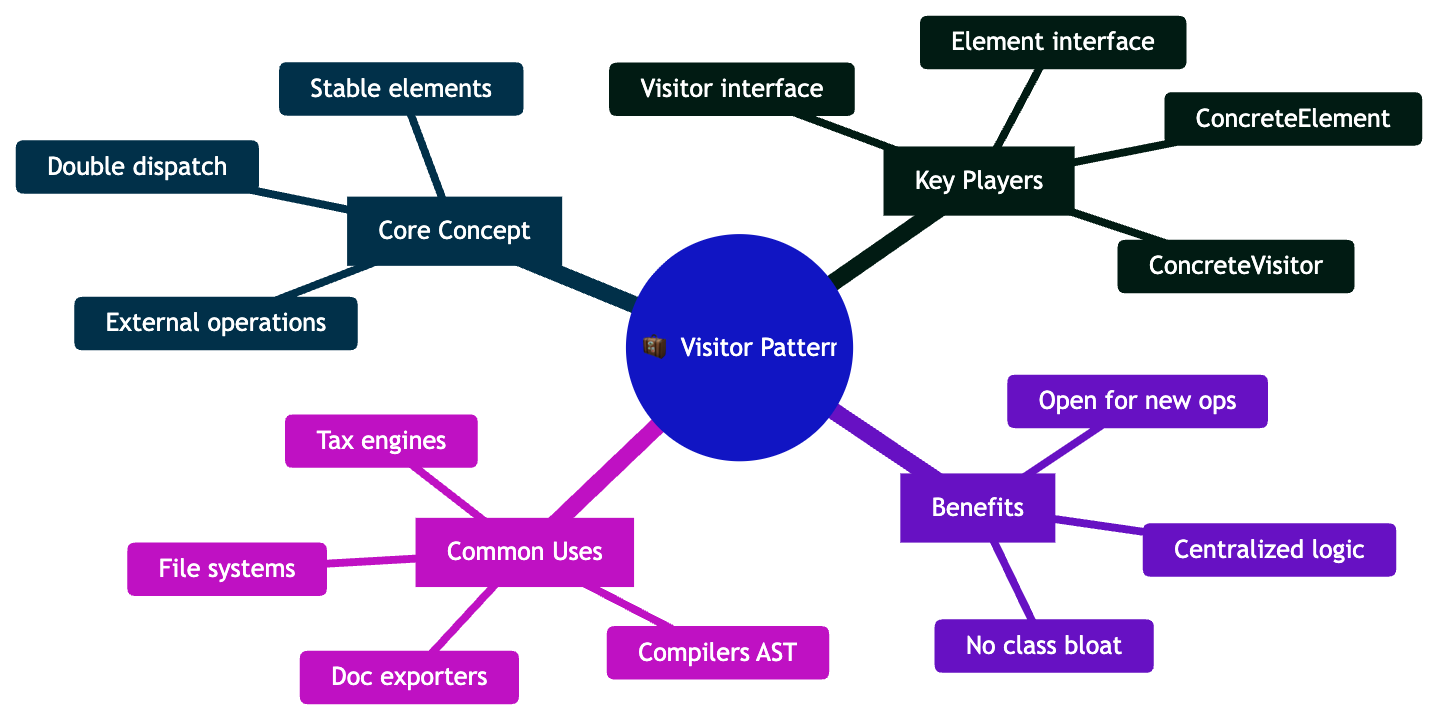
The Visitor Pattern is the go-to solution when you need to add operations to a stable class hierarchy without touching those classes. It's the engine behind compilers, document exporters, and static analysis tools.
Remember: Let the visitor do the work so the elements stay clean! 🧳
🎯 Key Takeaway
The Visitor Pattern is about adding behavior without modifying. When your class hierarchy is stable but your operations keep growing—visit it!
A developer was asked in a tech interview: "Explain the Visitor Pattern." She said, "It lets you add operations to classes without modifying them." The interviewer nodded. "Can you give a real-world example?" She replied, "Sure—it's how my manager keeps adding features to production without touching the design doc." 😄 Circle sighed, "Welcome to the pattern." 😄
Happy Visiting! 🧳✨


